"They Laughed When I Picked Up The Scythe... Until They Saw The Lethal Velocity, Rotational Force, And Raw Combat Power Of The World’s Most Feared Curved Blade!"
Discover the secret biomechanical system that converts "anime fantasy combat" into a brutal, high-volume, real-world martial art.
Re: Exclusive Underground Training & Movement Breakdown on Instagram
Dear Friend,
Let’s be honest with each other for a second.
Every "expert" in traditional martial arts will tell you the exact same thing: "A scythe is just a farm tool. It's too awkward, too slow, and totally impractical for real fighting."
They look at the long, sweeping curved blade and they panic. They don't understand leverage. They don't understand rotational physics. And they definitely don't understand how to turn momentum into an unstoppable flow state.
They couldn't be more wrong.
When I first looked closely at the scythe, I didn't just see an agricultural tool. I saw a hybrid halberd force-multiplier capable of generating terrifying amounts of torque and hook-control.
I realized a fundamental truth that most martial artists miss:
"If you can control, balance, and flow with a scythe... you can wield absolutely ANY weapon on Earth with supreme ease."
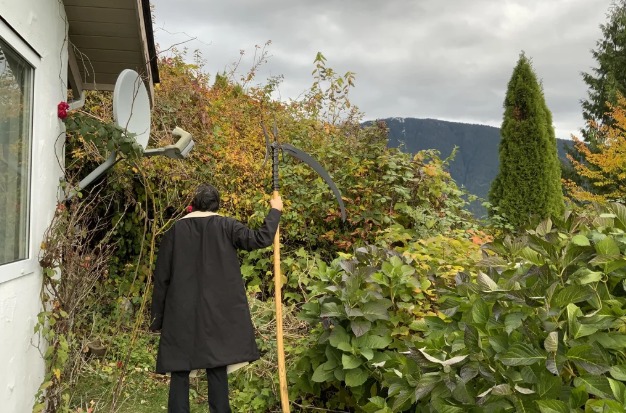
Why Most People Fail When Trying To Wield A Scythe
I'm not going to sugarcoat this: The scythe has a steep learning curve.
If you try to learn this weapon on your own through trial and error, it can be frustrating, tedious, and outright exhausting. Most people swing it around blindly like a prop, tire out their arms in two minutes, or worse—cause an injury.
Without proper body mechanics, you're fighting the weight of the blade instead of using gravity and centrifugal force to do the heavy lifting for you.
That is precisely why I created the Scythe School System.
I threw away the fake, flashy stage choreography and stripped the weapon down to core martial principles: Power-boxing hip rotation, structural leverage, continuous momentum loops, and high-volume footwork.
Here Is Just A Fraction Of What You Will See Inside Our Underground Instagram Feed:
- Raw Biomechanical Breakdown Clips: Visual guides on tracking the edge of the blade using micro-adjustments in your grip and stance.
- Rotational Power Drills: How we translate heavy boxing hip-torque to snap the scythe around with effortless, terrifying power.
- Continuous Flow Footwork: Uncut video demonstrations linking offensive slashes directly into defensive redirects without breaking momentum.
- Hooking & Disarm Applications: Real-time breakdowns on transforming the curved blade into a grappling force-multiplier to trip and control opponents.
- Direct Access & Community: Connect directly with the vanguard of long-lever weapon movement artists pushing the boundaries of physical combat.
Follow The Underground Movement @scytheschool
We are currently releasing raw training footage, technique breakdowns, and kinematic experiments daily. Tap into the underground network before the full academy platform officially opens.
Join The Scythe School Movement Today!
Get Instant Access To Daily Drills & Footage Breakdown
Traditional Martial Arts Seminars: $197
Instagram Access: 100% FREE
>> FOLLOW @SCYTHESCHOOL ON INSTAGRAM NOW <<⚡ Follow the official account to get tagged in upcoming live sessions and early video drops.
To your martial mastery,
Daniel
Founder, Scythe School Academy
P.S. Remember, the scythe forces you to understand subtle body awareness on a level that standard weapons simply cannot teach. Master the curve, and every other weapon becomes second nature. Click here to follow @scytheschool on Instagram now!